
Empowering Microsoft Partner Specializations: Definitive Guide to Secure More High‑Value Deals
Microsoft partner specializations sit on top of the Solutions Partner designations and signal focused, verifiable expertise in high‑demand solution areas such as Azure, Business Applications, Modern Work, and Security. They function as a credibility filter for customers and as an investment amplifier for partners, because the same technical depth that unlocks a specialization also unlocks incremental product benefits and go‑to‑market leverage.
What Microsoft partner specializations actually are?
Specializations are formal recognitions granted to partners who already hold a relevant Solutions Partner designation and can prove deep technical capability and customer success in a specific scenario or workload. They are not standalone badges you buy or opt into; they are an earned layer on top of the Microsoft AI Cloud Partner Program that demonstrates you have gone beyond baseline competency.
Each specialization maps to a solution area, and each area contains multiple focused specializations. For example, within Azure, you can have specialization in AI, analytics, migration, hybrid infrastructure, or virtual desktop, while within Security, you can specialize in cloud security, identity, data security, or threat protection. This structure lets customers quickly distinguish between a generic cloud partner and, for instance, a partner with repeated, audited success in Infra and Database Migration to Microsoft Azure or Identity and Access Management.
In practice, a specialization answers two customer questions at once: “Can this partner handle this specific scenario in depth?” and “Has Microsoft verified that claim through data, certifications, and audits or customer references?”
Solution areas and available specialization families
The specialization catalog is organized around Microsoft’s major solution areas, aligned with the Solutions Partner designations: Azure, Business Applications, Modern Work, and Security. Within each area, specializations target concrete technical and business outcomes rather than broad, abstract capabilities.
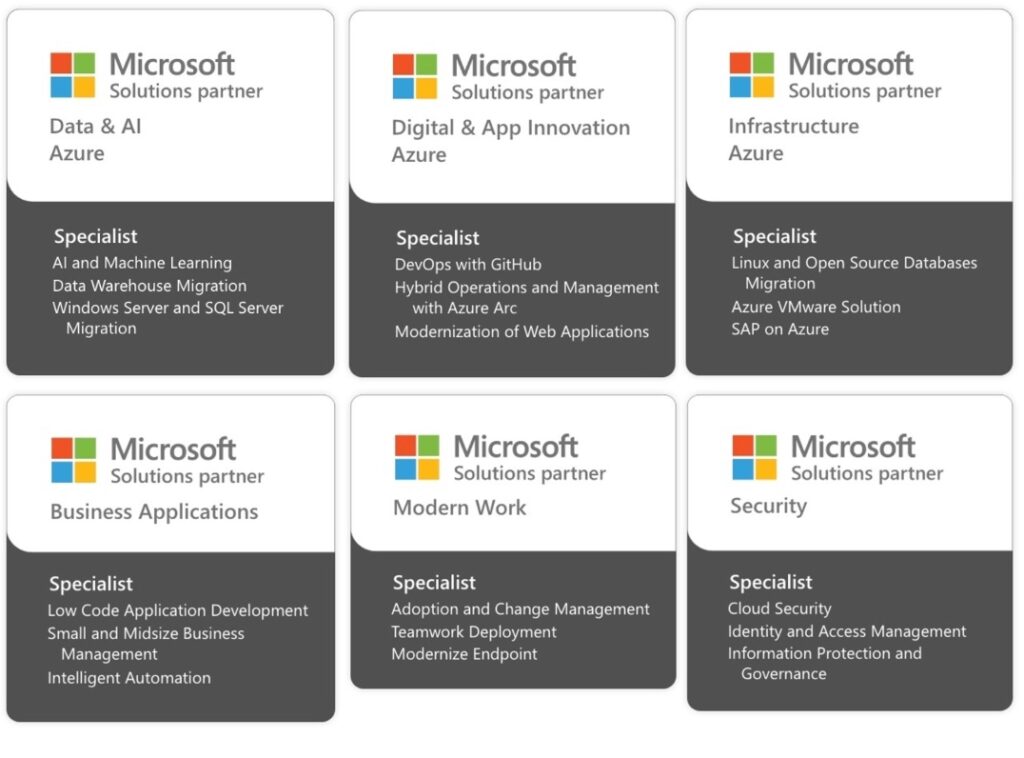
Azure specializations
Azure specializations cover data, AI, applications, infrastructure, and hybrid scenarios. Examples include:
- AI Platform on Microsoft Azure
- Analytics on Microsoft Azure
- Build AI Apps on Microsoft Azure
- Data Warehouse Migration to Microsoft Azure
- Accelerate Developer Productivity with Microsoft Azure
- Hybrid Cloud Infrastructure with Microsoft Azure Stack HCI
- Infra and Database Migration to Microsoft Azure
- Kubernetes on Microsoft Azure
- Microsoft Azure Virtual Desktop
- Microsoft Azure VMware Solution
- Migrate Enterprise Applications to Microsoft Azure
- Networking Services in Microsoft Azure
- SAP on Microsoft Azure
Collectively, these show whether a partner can modernize data platforms, build and run AI workloads, handle complex migrations, or design secure hybrid and multi‑cloud topologies on Azure at scale.
Business Applications specializations
Business Applications specializations focus on Dynamics 365 and Power Platform solution patterns that matter to line‑of‑business leaders. Current examples include:
- Business Intelligence
- Finance
- Intelligent Automation
- Microsoft Low Code Application Development
- Sales
- Service
- Small and Midsize Business Management
- Supply Chain
These indicate that a partner has proven implementation success and skills around specific business processes such as financial operations, sales and service, or supply chain optimization, often across multiple customer deployments.
Modern Work specializations
Modern Work specializations are centered on Microsoft 365, endpoint management, and collaboration experiences. Examples include:
- Adoption and Change Management
- Calling for Microsoft Teams
- Custom Solutions for Microsoft Teams
- Meetings and Meeting Rooms for Microsoft Teams
- Modernize Endpoints
- Teamwork Deployment
- Copilot
These are highly visible to customers who are standardizing on Teams, transforming meeting spaces, rolling out secure endpoint management, or adopting Microsoft Copilot capabilities at scale.
Security specializations
Security specializations map to key protection domains that CISOs care about:
- Cloud Security
- Identity and Access Management
- Data Security (formerly Information Protection and Governance)
- Threat Protection
Partners with these specializations have demonstrated both technical proficiency and real‑world deployments in areas such as hardening cloud workloads, implementing robust identity controls, protecting sensitive data, and detecting and responding to advanced threats.
Why specializations matter for partners and customers
Specializations serve both as a market signal and a benefits gateway. On the market side, they differentiate a partner in crowded categories where many organizations hold the same base designation but few can show deep, scenario‑specific evidence. For customers, specializations simplify partner selection by tying recognized labels to concrete workloads and outcomes such as SAP on Azure, Copilot adoption, or Data Security.
For partners, holding a specialization can influence search ranking and exposure in Microsoft partner listings, and it often becomes a deciding factor in enterprise RFPs and tenders where buyers explicitly filter for specialized partners. Internally, pursuing a specialization sharpens technical focus: it pushes teams to meet defined performance metrics, skilling thresholds, and customer success proof points rather than loosely defined “expertise”.
Specializations also tie into product benefits. When a partner with a relevant Solutions Partner designation elects to purchase Solutions Partner benefits, earning specializations in that category unlocks incremental benefits up to a defined cap per solution area. This means that the investment in technical excellence returns not only in customer trust but also in additional licenses, credits, or other programmatic benefits that support further growth.
Qualification requirements and enrollment mechanics
Specializations are not automatically granted when you hit the Solutions Partner designation. Each specialization has qualification requirements that typically combine three dimensions: eligibility, performance, and skilling, plus scenario‑specific requirements such as audits or customer references.
At a high level:
- You must hold the aligned Solutions Partner designation for the solution area you are targeting.
- You must meet performance or impact thresholds, such as revenue, usage, or deployment milestones, defined for that specialization.
- You must meet skilling requirements, typically measured through specific technical certifications or exams across your staff.
The enrollment flow differs slightly by solution area:
1. Azure specializations
You must meet all qualification requirements and then schedule and pass an audit conducted by an approved auditor; the audit can only be scheduled after the platform indicates that qualification requirements are met.
2. Modern Work and Security specializations
You must meet qualification requirements and then submit customer references for manual validation; references can only be submitted once you already meet the basic qualification criteria.
3. Business Applications specializations
Once you meet the qualification requirements, enrollment is automatic; there is no separate enrollment step beyond satisfying the published metrics.
How specialization product benefits work
Specializations are tied to incremental product benefits layered on top of the base Solutions Partner benefits, with caps per category. Benefits are provisioned when you purchase Solutions Partner benefits and hold qualifying specializations, and they remain valid until the end of your Solutions Partner membership term.
Each solution area category has a maximum number of specializations or expert program enrollments that can contribute incremental benefits
1. Azure category
Up to five product benefits across programs such as Azure Expert MSP, Infra and Database Migration to Microsoft Azure, SAP on Microsoft Azure, Data Warehouse Migration to Microsoft Azure, Kubernetes on Microsoft Azure, Migrate Enterprise Apps to Microsoft Azure, Microsoft Azure Virtual Desktop, Analytics on Microsoft Azure, Microsoft Azure VMware Solution, AI Platform on Microsoft Azure, Accelerate Developer Productivity with Microsoft Azure, Build AI Apps on Microsoft Azure, Hybrid Cloud Infrastructure with Microsoft Azure Stack HCI, and Networking Services in Microsoft Azure.
2. Business Applications category
Up to three product benefits across specializations, including Microsoft Low Code Application Development, Business Intelligence, Intelligent Automation, Small and Midsize Business Management, Sales, Service, Finance, and Supply Chain.
3. Modern Work category
Up to three product benefits across specializations such as Adoption and Change Management, Calling for Microsoft Teams, Custom Solutions for Microsoft Teams, Meetings and Meeting Rooms for Microsoft Teams, Modernize Endpoints, Copilot, and Teamwork Deployment.
4. Security category
Up to three product benefits across Cloud Security, Identity and Access Management, Data Security, and Threat Protection.
If a partner exceeds the cap in a category, newly earned specializations in that category do not unlock additional product benefits, although the specialization recognition itself still applies. For example, a partner already holding Cloud Security, Identity and Access Management, and Data Security would receive three Security benefits; adding Threat Protection would not increase that count beyond the category cap of three.
This cap system encourages deliberate focus on which specializations to prioritize within each solution area while preventing unlimited stacking of benefits.
Enrollment lifecycle, validity, and renewal behavior
Once a partner enrolls in a specialization, the enrollment is valid for one year up to the “Valid till” date, including a defined grace period, even if some qualification requirements are temporarily not met during that period. This design prevents short‑term fluctuations in metrics or changes in personnel from immediately stripping the specialization.
However, renewal is contingent on meeting all qualification requirements within a defined renewal window:
- The renewal window opens 60 days before the anniversary date and closes 30 days after, effectively giving partners 90 days to re‑meet the published qualification requirements.
- If the partner meets the requirements during this window, the specialization is renewed; otherwise, enrollment ends after the grace period.
The renewal process is structured across multi‑year cycles:
- Year one (first anniversary)
Renewal requires meeting qualification requirements; no new audit or customer reference submission is needed if those were completed at initial enrollment or earlier. - Year two (second anniversary)
Renewal requires both meeting qualification requirements and completing manually validated requirements (audit or customer references), which are revalidated every other year. - Years three and beyond
The pattern repeats, with qualification requirements checked annually and audit or customer reference requirements revalidated every second year (odd years for automatic renewal, even years for renewal plus manual validation).
The program sends multiple reminders to the Partner Center admin: at 120, 90, 60, and 30 days before the anniversary date, on the anniversary date itself, and 30 days after, and these notifications also appear inside Partner Center. This cadence is intended to reduce accidental lapses where partners meet requirements but fail to act within the renewal window.
Importantly, if a partner temporarily loses the underlying Solutions Partner designation or fails to meet a qualification requirement during the year, the specialization remains active until the “Valid till” date; only at renewal does the system enforce alignment with all requirements again.
When Requirements Shift: Designations, Qualifications, and Benefits
The specialization framework explicitly accounts for common partner lifecycle issues, such as lapses in the base designation or performance dips. If a partner loses the Solutions Partner designation or fails some qualification requirement after enrolling in a specialization, they do not immediately lose the specialization; enrollment stays intact for the remainder of the current one‑year term.
However, to be re‑enrolled at the next renewal, all qualification requirements must be satisfied within the renewal window, including regaining any lost Solutions Partner designation or closing gaps in performance, skilling, or marketplace publishing. The same logic applies if a partner never received all expected product benefits: if the solution area’s maximum benefits cap is already reached, additional specializations in that category will not unlock more benefits even though the specialization is valid.
This makes it critical for partners to monitor three separate but related dimensions:
- Solutions Partner designation status per solution area.
- Specialization qualification metrics, which can shift over time.
- Benefit caps and current usage per category so expectations about additional benefits are realistic.
Strategic use of specializations in a partner go to market
From a strategic standpoint, specializations allow a partner to translate technical depth into visible differentiation and structural advantages inside the Microsoft ecosystem. They can be used to anchor focus around specific solution plays, for example:
- A data and AI-focused partner prioritizing Analytics on Microsoft Azure, AI Platform on Microsoft Azure, and Build AI Apps on Microsoft Azure to align with modern AI demand.
- An infrastructure partner targeting Infra and Database Migration to Microsoft Azure, Hybrid Cloud Infrastructure with Microsoft Azure Stack HCI, and SAP on Microsoft Azure to win large migration and modernization projects.
- A security‑centric partner building a stack across Cloud Security, Identity and Access Management, Data Security, and Threat Protection to align with CISO‑level concerns.
Internally, the qualification requirements drive investment in certifications, solution accelerators, and repeatable delivery patterns; externally, the specializations act as shorthand for that investment when customers and Microsoft field teams assess partner fit for opportunities.
Because enrollment and renewal are tightly linked to measurable criteria and periodic audits or customer reference checks, maintaining specializations pushes partners to sustain quality rather than treat the badge as a one‑time milestone. Over time, a portfolio of carefully chosen specializations can become the backbone of a partner’s identity in the Microsoft ecosystem, guiding hiring, training, solution development, and go‑to‑market alignment.
Summing it up
Microsoft partner specializations are advanced recognitions layered on top of Solutions Partner designations that prove deep, scenario‑specific expertise in high‑demand areas like Azure, Business Applications, Modern Work, and Security. They are not purchased; they are earned by meeting strict performance, skilling, and customer success requirements, and in some cases passing audits or customer reference validations. This turns them into a credible signal for customers that a partner has repeatedly delivered successful projects in a clearly defined workload, such as SAP on Azure, Copilot deployment, or Identity and Access Management, rather than just claiming generic cloud or security capability.
For partners, specializations are both a market differentiator and a structural advantage inside the Microsoft ecosystem. They influence visibility in partner listings and RFPs, drive internal focus on certifications and repeatable delivery patterns, and unlock incremental product benefits tied to specific solution areas up to defined caps. Enrollment is time‑bound, with a one‑year validity and a structured renewal cycle that checks qualification requirements annually and revalidates audits or customer references every other year. This forces partners to maintain performance and technical quality over time. Strategically, a carefully chosen mix of specializations becomes the backbone of a partner’s identity, guiding hiring, training, and go‑to‑market choices around the scenarios where they can win and deliver the most value.
Frequently Asked Questions (FAQ)
What are Microsoft partner specializations, in practical terms?
Microsoft partner specializations are formal recognitions awarded to partners who prove deep technical and delivery expertise in specific solution scenarios, on top of already holding a relevant Solutions Partner designation. Practically, this means that a partner does not just work “on Azure” or “in security,” but has demonstrated consistent, measurable success in a defined area such as Infra and Database Migration to Microsoft Azure, Business Intelligence, Modernize Endpoints, or Cloud Security. To obtain a specialization, a partner must meet a set of published requirements that typically include performance metrics (like deployments or usage), staff certifications, and evidence of successful customer projects. In some categories, an independent audit or customer reference validation is required to confirm that the partner’s delivery approach, governance, and outcomes meet Microsoft’s standards. The result is a badge that customers and Microsoft field teams can rely on as a shorthand for proven capability in a tightly scoped workload.
How do specializations differ from Solutions Partner designations?
Solutions Partner designations establish that a partner meets broad, solution‑area‑level criteria across performance, skilling, and customer success for areas such as Azure, Business Applications, Modern Work, or Security. They answer the question, “Is this partner generally strong in this domain?” Specializations, by contrast, narrow the focus and go deeper into particular workloads or scenarios. For example, two partners might both hold the Solutions Partner designation for Azure, but only one might have Analytics on Microsoft Azure and SAP on Microsoft Azure specializations that prove specific strengths in those use cases. Specializations also require additional validation that goes beyond what is needed for the base designation, such as third‑party audits or samples of real customer deployments. In effect, the designation is the foundation that allows you to compete broadly in a solution area, while specializations are targeted proof points that help you stand out in particular types of engagements where customers want evidence of repeated, specialized success.
What types of specializations are available across solution areas?
The specialization catalog is grouped into the four major solution areas aligned with the Microsoft AI Cloud Partner Program. In the Azure area, specializations cover AI platforms, analytics, data warehouse migration, enterprise application migration, Kubernetes, Azure Virtual Desktop, VMware migration, hybrid infrastructure with Azure Stack HCI, networking, SAP on Azure, and developer productivity and AI app building. Business Applications specializations focus on Dynamics 365 and Power Platform scenarios such as Business Intelligence, Finance, Intelligent Automation, Low Code Application Development, Sales, Service, Small and Midsize Business Management, and Supply Chain. Modern Work specializations address Microsoft 365 and collaboration use cases, including Adoption and Change Management, Teams calling and meetings, custom Teams solutions, endpoint modernization, Teamwork deployment, and Copilot. Security specializations span Cloud Security, Identity and Access Management, Data Security, and Threat Protection. Each specialization maps to a discrete, real‑world need, so customers can quickly identify partners suited to their specific projects rather than sifting through generic labels.
What are the main qualification requirements to enroll in a specialization?
To enroll in a Microsoft partner specialization, a partner must satisfy several layers of requirements. First, the partner must hold the relevant Solutions Partner designation in the same solution area, such as Solutions Partner for Azure before pursuing an Azure specialization. Second, they must meet quantitative qualification requirements, which usually include performance metrics (like customer deployments, usage, or revenue tied to that workload) and skilling metrics (a certain number of certified individuals with specified exams or certifications). Third, depending on the specialization, they may need to complete either an independent audit or submit validated customer references. Azure specializations typically require scheduling and passing an audit after all other criteria are met, while many Modern Work and Security specializations rely on customer references that demonstrate successful implementations. Business Applications specializations, once the metrics are satisfied, are generally auto‑enrolled without a separate audit step. This layered model ensures that the badge represents sustained technical capability and real customer impact, not just theoretical knowledge.
How do product benefits tied to specializations work, and what are benefit caps?
Specializations unlock incremental product benefits when a partner has also opted into and paid for Solutions Partner benefits in the same solution area. These benefits can include additional licenses, cloud credits, or other programmatic advantages that enhance a partner’s ability to build, test, and sell solutions. However, Microsoft sets a cap on how many specializations or expert programs per solution area can contribute to these additional benefits. For instance, the Azure category has a higher cap, allowing up to a certain number of specializations or expert programs to generate incremental benefits, while Business Applications, Modern Work, and Security categories generally offer a lower cap. Once the cap is reached in a category, any extra specializations earned in that area still count from a recognition and differentiation standpoint but do not add further product benefits beyond the maximum. This structure incentivizes partners to prioritize the specializations that most align with their strategy, rather than collecting every possible badge solely to accumulate benefits, and it ensures that benefits remain balanced across the ecosystem.
How long does a specialization remain valid, and how does renewal work?
A specialization is typically valid for one year from the enrollment date, up to the listed “Valid till” date, with an additional grace period. During this year, even if the partner temporarily falls short on some qualification metrics or loses the underlying Solutions Partner designation, the specialization remains active. Renewal is governed by a defined window that opens 60 days before the anniversary date and closes 30 days after, effectively granting a 90‑day period during which the partner must once again meet all qualification requirements for that specialization. The renewal cadence follows a multi‑year pattern: in the first anniversary year, only the qualification requirements need to be revalidated; audits or customer references, once accepted, usually remain valid for two years. In the second anniversary year, the partner must both meet updated qualification requirements and complete the relevant manual validation, such as a repeat audit or new customer references. This alternating cycle continues in subsequent years, enforcing continuous performance and periodic deep checks without imposing full manual validation every single year. Partners receive multiple reminder notifications well before and after the anniversary date, both via email and within Partner Center, to minimize accidental lapses.
What happens if a partner loses their Solutions Partner designation or fails to meet requirements mid‑term?
If a partner loses the underlying Solutions Partner designation or fails to maintain one of the qualification requirements during the active term of a specialization, they do not immediately lose the specialization. The enrollment remains intact until the current “Valid till” date, including the grace period. This is designed to accommodate normal business fluctuations, staffing changes, or short‑term dips in metrics without penalizing partners instantly. However, at renewal time the system enforces full compliance. To be reenrolled for the next term, the partner must re‑attain the relevant Solutions Partner designation and satisfy all updated qualification requirements during the renewal window. If they do not, the specialization will not renew and effectively expires. Similarly, if a partner expects additional product benefits from a new specialization but has already reached the benefit cap for that category, they will not receive extra benefits even though the specialization itself is valid. This separation between recognition, qualification, and benefits means partners must monitor their designation status, specialization metrics, and benefit caps rather than assuming that once a badge is earned, it continues indefinitely without active maintenance.
How should a partner strategically choose which specializations to pursue?
Partners should approach specializations as strategic investments that align with their existing strengths, target customers, and growth plans rather than treating them as generic badges to collect. The first step is to identify the core solution plays the business wants to lead with, such as complex Azure migrations, AI and analytics, industry‑specific Dynamics workloads, secure hybrid work, or end‑to‑end security services. From there, partners can map these plays to relevant specializations, focusing on those that are frequently mentioned in RFPs, valued by Microsoft sales teams, or directly connected to high‑margin services they already deliver or intend to build. Because each specialization carries performance and skilling requirements, partners need to assess whether they can realistically achieve and maintain those thresholds through training, hiring, and project execution. They should also consider benefit caps: if a solution area already has enough specializations to hit the cap, new ones may still be valuable for differentiation but will not increase product benefits. Over time, a deliberate portfolio of specializations can sharpen a partner’s market identity, guide competency development, and signal to customers that the partner is not only broadly capable but deeply committed to a small number of well‑defined, high‑impact scenarios.