
Partner’s Guide to Microsoft 365 E7 and Agent 365
The landscape of artificial intelligence is shifting from a period of experimental pilots to an era of large-scale organizational transformation. As of May 1, 2026, Microsoft has officially announced the general availability of Microsoft 365 E7 and Microsoft Agent 365. This milestone provides Microsoft partners with a comprehensive framework to move their customers beyond the “what” of AI and into a structured, secure, and governed “how”. By establishing Intelligence + Trust as the core foundation, Microsoft 365 E7 enables organizations to evolve into “Frontier Firms” enterprises that are human-led but agent-operated.
Table of Contents
- The Foundation: What is Microsoft 365 E7?
- Microsoft Agent 365: The Enterprise Control Plane
- Monetization for Services Partners
- Repeatable Growth for Channel Partners
- Innovation for Software Development Companies (SDCs)
- Financial Incentives and Promotional Offers
- Partner Readiness: Next Steps for Success
Key Takeaways
- General Availability: Microsoft 365 E7 and Agent 365 are now transactable as of May 1, 2026.
- Integrated Power: The E7 suite combines M365 E5, Entra Suite, Copilot, and Agent 365 into one solution.
- Governance First: Agent 365 acts as a central control plane for managing “AI teammates” and discovery of shadow AI.
- Partner Revenue: New opportunities exist in Governance Accelerators, managed services, and custom agent development for SDCs.
- Financial Incentives: Discounts of 10% to 15% are available for eligible 1-year and 3-year E7 terms.
The Foundation: What is Microsoft 365 E7?
Microsoft 365 E7, also referred to as the Frontier Suite, is designed to serve as the structural foundation for modern enterprises. Rather than requiring partners to stitch together various point solutions, E7 integrates four critical pillars into a single suite:
- Microsoft 365 E5: This remains the gold standard for enterprise-grade productivity, identity management, and advanced security and compliance.
- Microsoft Entra Suite: It provides the necessary identity and network access controls to ensure employees can use applications and AI securely.
- Microsoft 365 Copilot: This embeds generative AI directly into the flow of daily work, enhancing productivity across the organization.
- Microsoft Agent 365: A new addition that serves as the governing control plane for observing and securing AI agents at scale.
For partners, this consolidated suite simplifies the sales conversation, allowing them to anchor customer strategy on a single foundation for both human users and AI agents.
Microsoft Agent 365: The Enterprise Control Plane
As organizations scale their AI usage, the focus shifts from individual productivity to the management of “AI teammates”. Microsoft Agent 365 is now generally available to facilitate this transition, with licensing covering individuals who manage, sponsor, or utilize agents for work.
Agent 365 introduces several advanced capabilities currently in preview to ensure scale does not outpace trust:
- Observability and Governance: It allows for the monitoring of agents that may operate with their own specific credentials and permissions.
- Discovery of Shadow AI: By leveraging Microsoft Defender, Entra, Intune, and Purview, organizations can identify unauthorized “shadow AI” and agents across local and cloud environments.
- Secure Environments: Through Windows 365 for Agents, organizations can provide a managed, secure environment for agents to perform tasks.
- Broad Ecosystem Support: The tool is designed to cover a wide range of SaaS agents, including those developed by third-party software companies.
CISOs can now utilize a “single pane of glass” to gain real-time visibility into agent behavior, ensuring innovation remains compliant and secure.
Monetization for Service Partners
The shift toward a governance-first model creates significant new revenue streams for service partners. Microsoft identifies three primary engagement models that partners can deploy to help customers adopt agents responsibly:
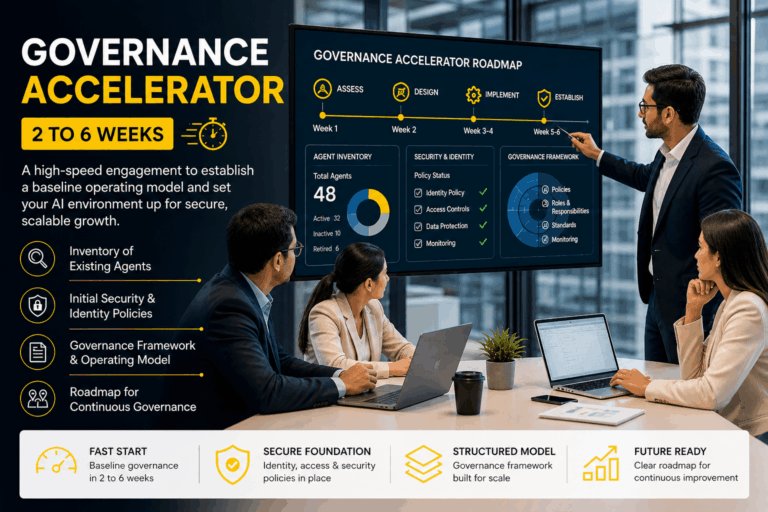
Governance Accelerator (2 to 6 weeks)
This is a high-speed engagement designed to establish a baseline operating model. It typically includes creating an inventory of existing agents, setting up initial security and identity policies, and defining a governance framework and roadmap.
End-to-End Transformation
This represents a more comprehensive journey, covering strategy, architecture, and deployment. It involves deep readiness assessments, identity/security architecture design, and organizational change management to ensure adoption.
Managed Governance
This provides ongoing recurring revenue. Partners can offer continuous monitoring of agent compliance, manage the lifecycle of agents from deployment to retirement, and provide executive risk reporting through dashboards.
Repeatable Growth for Channel Partners
For channel partners, the strategy revolves around standardizing the upgrade path to E7. High-propensity targets include existing M365 E3 or E5 customers who are already using Copilot.
Partners can drive value by attaching readiness workshops and security assessments to the initial license sale. By establishing an operating rhythm that eventually evolves into managed services, channel partners can ensure sustained usage and expansion within their customer base. Microsoft has also aligned Cloud Solution Provider (CSP) incentives to these outcomes, rewarding partners for driving meaningful customer expansion.
Innovation for Software Development Companies (SDCs)
Enterprises are no longer just looking for AI tools; they are looking for agents that are secure, governed, and observable. This demand creates a unique opening for SDCs to build solutions that integrate directly with Agent 365.
Key opportunities for SDCs include:
- Line-of-Business Integrations: Connecting agents to ERP, CRM, and proprietary ticketing systems using secure access patterns.
- Vertical-Specific Solutions: Developing packaged agents for specific industry needs, such as healthcare scheduling or financial services onboarding.
- Legacy Modernization: Upgrading traditional, “brittle” scripts and rule-based automation into intelligent, agentic workflows that can reason across multiple systems.
- Copilot Extensions: Building custom agents that extend the capabilities of Microsoft 365 Copilot into specialized professional tools.
Financial Incentives and Promotional Offers
To support the launch and accelerate partner momentum, Microsoft has introduced several promotional offers for Microsoft 365 E7:
- 1-Year Terms: Partners can offer 10% or 15% off, depending on seat minimums.
- 3-Year Terms: A 15% discount is available for customers with a minimum of 300 seats. Note that these 3-year offers currently require an upfront billing option.
Partners are encouraged to consult the Global Promo Readiness Guide for the most up-to-date details on transactability and eligibility.
Partner Readiness: Next Steps for Success
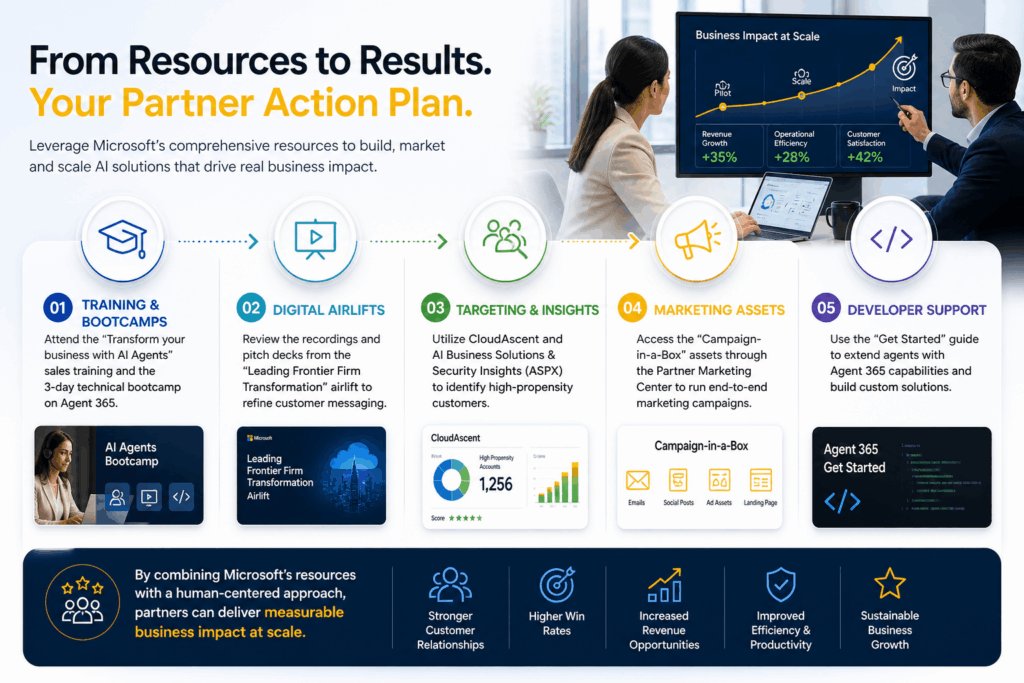
To capitalize on the general availability of these products, Microsoft has provided a comprehensive checklist for partner action:
- Training and Bootcamps: Partners should attend the “Transform your business with AI Agents” sales training and the 3-day technical bootcamp focused on implementing Agent 365.
- Digital Airlifts: Review the recordings and pitch decks from the “Leading Frontier Firm Transformation” airlift to refine customer messaging.
- Targeting and Insights: Utilize CloudAscent and AI Business Solutions & Security Insights (ASPX) to identify high-propensity customers.
- Marketing Assets: Access the “Campaign-in-a-Box” assets through the Partner Marketing Center to run end-to-end marketing campaigns.
- Developer Support: For those building custom solutions, the “Get Started” guide provides instructions on how to extend agents with Agent 365 capabilities.
By combining these resources with a human-centered approach, partners can move beyond simple pilots and help their clients deliver measurable business impact at scale.
Frequently Asked Questions (FAQs)
What is Microsoft 365 E7?
Microsoft 365 E7 is a next-generation enterprise offering that combines productivity, AI, security, and identity into a unified solution. It builds on existing Microsoft 365 capabilities by deeply integrating AI (like Copilot), advanced security, and identity governance into a single operating model for modern organizations.
How is Microsoft 365 E7 different from E5?
While E5 focuses on productivity, security, and compliance, E7 extends this by embedding AI across workflows and introducing a more integrated identity-first architecture. It is designed not just as a licensing upgrade, but as a shift toward AI-powered, automated enterprise operations with built-in governance.
What role does AI play in Microsoft 365 E7?
AI is central to E7. It enables:
- Real-time assistance inside apps like Word, Excel, and Outlook
- Automated workflows and intelligent agents
- Faster decision-making through data insights
- Enhanced security operations using AI-driven threat detection
E7 makes AI part of daily work rather than a separate tool.
What is “Agent-based work” in the context of E7?
Agent-based work refers to AI-driven assistants that can perform tasks, automate processes, and support decision-making. In E7, these agents are governed, secure, and integrated into enterprise systems, making them reliable for real business operations, not just experimentation.
How does E7 improve enterprise security?
E7 strengthens security by combining identity, device, and data protection into a unified model. It uses AI to:
- Detect and respond to threats faster
- Correlate signals across multiple systems
- Automate security operations
This reduces response time and improves overall security posture.
Is Microsoft 365 E7 only for large enterprises?
E7 is primarily designed for large enterprises and organizations with complex environments. However, partners and growing organizations can also adopt its model to prepare for AI-driven operations and advanced security requirements.
What does E7 mean for Microsoft partners?
For partners, E7 opens new opportunities in:
- AI implementation and advisory services
- Security and identity transformation projects
- Copilot and automation deployments
- Governance and compliance consulting
It shifts partner value from licensing to strategic transformation.
Does E7 replace existing Microsoft 365 plans?
E7 does not simply replace existing plans but builds on top of them as a more advanced offering. Organizations may transition based on their maturity in AI adoption, security needs, and operational complexity.
What should organizations consider before adopting E7?
Before adopting E7, organizations should evaluate:
- Their identity and security maturity
- Readiness for AI integration
- Data governance and compliance requirements
- Existing Microsoft ecosystem usage
A structured approach ensures successful adoption and value realization.