
Microsoft Marketplace-First Co-Sell in FY27: What Partners Need to Know
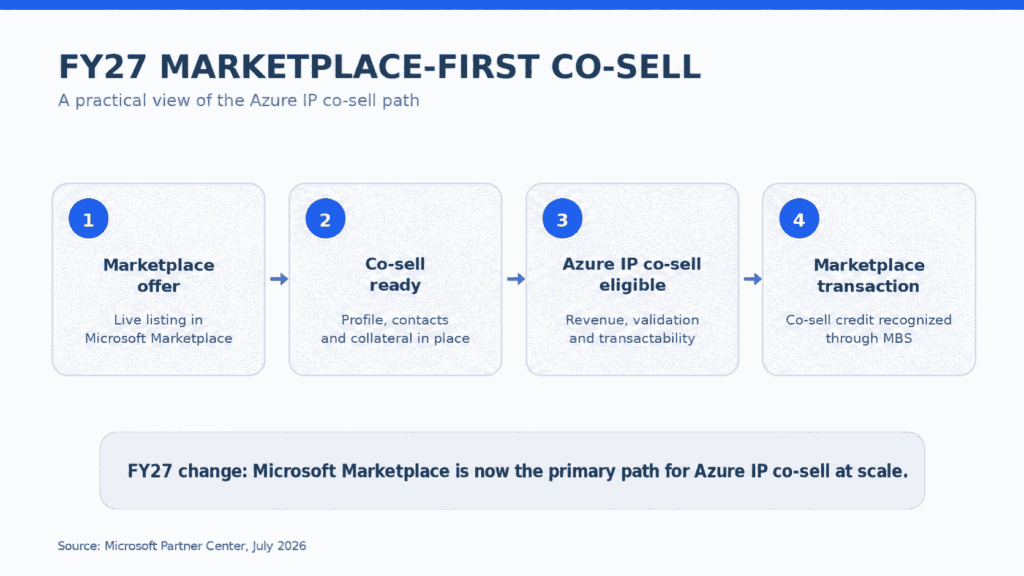
Microsoft has made an important change to its Azure IP co-sell strategy for FY27. In its July 10, 2026 Partner Center announcement, Microsoft said Marketplace is now the primary path for co-sell at scale, giving Microsoft and its partners a more consistent way to connect joint selling with verified Marketplace transactions.
For software companies and other partners involved in Azure IP co-sell, the change raises practical questions. What happens to PRACR? Does every offer need to be transactable? Is co-sell-ready status still relevant? And what should partners review in Partner Center now?
The short answer is that co-sell is not going away. Microsoft is changing how scalable co-sell is expected to work and how partner impact is recognized.
This guide explains the FY27 Microsoft Marketplace-first co-sell direction, the difference between key co-sell statuses, and the steps partners should take to prepare. For a broader view of Microsoft’s priorities this fiscal year, see the Alif Partner Portal’s overview of MCAPS Start for Partners 2026 and FY27 priorities.
FY27 timing: Microsoft’s FY27 runs from July 1, 2026 through June 30, 2027. Microsoft announced the Azure IP co-sell changes on July 10, 2026.
Table of Contents
- What Changed With Microsoft Co-Sell in FY27?
- What “Marketplace-First” Means for Partners
- Co-Sell Ready vs. Azure IP Co-Sell Eligible
- What Happens to PRACR in FY27?
- Who Needs to Pay the Most Attention?
- What Microsoft Partners Should Review Now
- Frequently Asked Questions
Key Takeaways
- Microsoft says Marketplace is now the primary path for Azure IP co-sell at scale in FY27, with the July 10 update focused most directly on Software Development Companies (SDCs).
- PRACR no longer operates as a broad co-sell mechanism in FY27; Microsoft says Marketplace transactions continue to receive co-sell recognition through Marketplace Billed Sales (MBS).
- Co-sell ready and Azure IP co-sell eligible remain different statuses. Azure IP eligibility adds requirements such as the current revenue threshold, Azure technical validation, and Marketplace transactability.
- Partners should review each relevant offer’s Marketplace status, transactability, co-sell status, MBS/ACR performance, and internal sales process against current Partner Center guidance.
What Changed With Microsoft Co-Sell in FY27?
Microsoft describes Azure IP co-sell as its joint go-to-market motion for qualified partner solutions. In its July 2026 Partner Center announcement, Microsoft said it is moving away from legacy partner-reported approaches and toward a more automated, Marketplace-first model.
The main change is straightforward: Microsoft Marketplace is now the expected path for scalable, consistent Azure IP co-sell execution.
Microsoft points to verified transactions, clearer alignment between partners and Microsoft sellers, and more predictable outcomes as reasons for the change.
The update also changes the role of Partner Reported Azure Consumed Revenue (PRACR). Microsoft states that PRACR no longer operates as a broad co-sell mechanism in FY27. For transactions completed through Marketplace, co-sell credit continues to be recognized through Marketplace Billed Sales (MBS).
Here is a simplified view of the change:
Area | Earlier approach | FY27 direction |
Co-sell at scale | Included partner-reported mechanisms such as PRACR | Marketplace-first execution |
Transaction evidence | Could include partner-reported impact | Greater emphasis on verified Marketplace transactions |
Marketplace role | Important route for eligible offers | Primary path for scalable co-sell |
Marketplace transaction recognition | MBS already existed | MBS continues to recognize co-sell credit for Marketplace transactions |
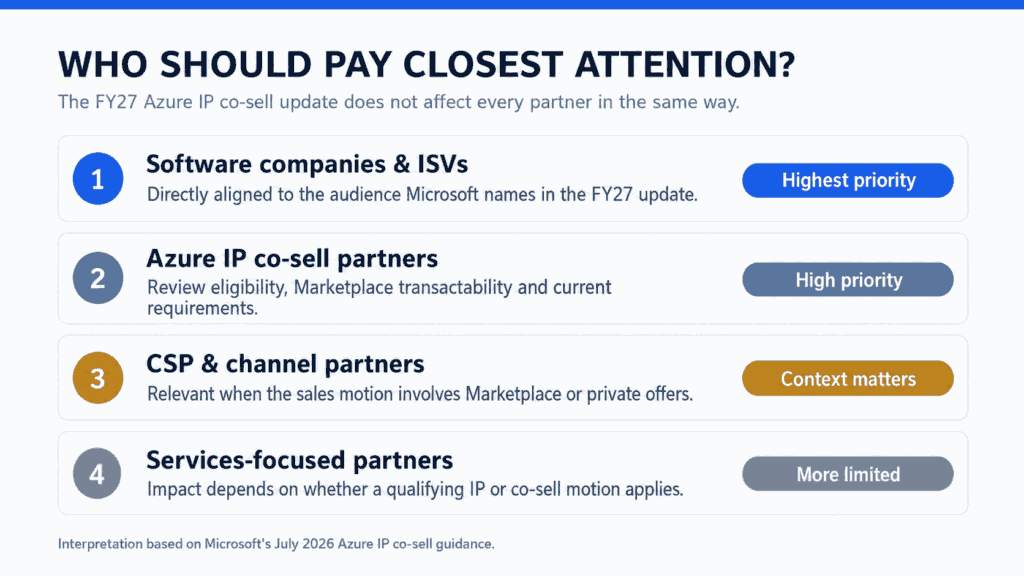
There is an important limitation to keep in mind. Microsoft’s July 10 announcement specifically identifies Software Development Companies (SDCs) as the impacted audience and discusses Azure IP co-sell. It should not be interpreted as a statement that every CSP, MSP, or services-only partner must suddenly transact every customer engagement through Marketplace.
Why Is Microsoft Moving to Marketplace-First Co-Sell?
The shift is less about changing the idea of co-selling and more about making the commercial path easier to verify and repeat.
Under a Marketplace transaction, the commercial activity is recorded within Microsoft’s Marketplace systems. That gives partners and Microsoft a common transaction record rather than relying as heavily on partner-reported activity.
Microsoft says the Marketplace-first model is intended to provide a more transparent, automated, auditable, and predictable approach to recognizing partner impact.
Marketplace also plays a wider role in Microsoft’s partner strategy. Eligible Azure IP co-sell offers can contribute toward a customer’s Microsoft Azure Consumption Commitment (MACC), and Marketplace performance can affect eligibility for certain Marketplace benefits.
For partners, this means Marketplace readiness is becoming part of co-sell readiness—not a separate task that can always be handled later.
What Does “Marketplace-First” Mean for Partners?
The phrase can sound broader than it is. Marketplace-first does not mean that every Microsoft partner needs the same type of Marketplace offer or co-sell status.
It does mean that software companies pursuing Azure IP co-sell should understand how their offer is published, whether it can transact through Marketplace, its current co-sell status, and how Marketplace sales are being measured.
Three distinctions matter most.
A Marketplace listing is not automatically a transactable offer ?
An offer can be live in Microsoft Marketplace without customers completing the full purchase through Marketplace.
This distinction matters because Azure IP co-sell eligibility includes Marketplace transactability as a requirement. Simply being listed does not, by itself, satisfy all Azure IP co-sell requirements.
Partners should review each offer individually rather than assume that a Marketplace presence means the offer is ready for the FY27 motion.
Co-sell ready is not the same as Azure IP co-sell eligible
Microsoft currently uses several co-sell statuses. For Azure offers, the main statuses include In market, Co-sell ready, and Azure IP co-sell eligible. Microsoft’s co-sell overview explains how these statuses fit within the broader co-sell process.
An offer can therefore be published in Marketplace without having reached co-sell-ready or Azure IP co-sell eligible status.
Marketplace performance now deserves closer attention
Marketplace Billed Sales, or MBS, represents sales billed through Microsoft Marketplace. Microsoft’s FY27 announcement specifically says co-sell credit for Marketplace transactions continues to be recognized through MBS.
MBS should not be treated as another name for PRACR or Azure Consumed Revenue. These measures serve different purposes within Microsoft’s partner programs and eligibility models.
Co-Sell Ready vs. Azure IP Co-Sell Eligible
This is one of the most important distinctions for partners to understand.
What does co-sell ready mean?
According to Microsoft’s current co-sell requirements, a solution needs several items in place to become co-sell ready. These include an active Marketplace account and Partner ID, a complete business profile, a live Marketplace offer, sales contacts for the relevant geographies, and the required information and collateral on the Co-sell > Solutions page in Partner Center.
Microsoft also requires the relevant one-pager and pitch deck information for the co-sell solution.
For professional services solutions, Microsoft states that services partners need at least one Solutions Partner designation in the Microsoft AI Cloud Partner Program as part of the co-sell-ready requirements.
What does Azure IP co-sell eligible mean?
Azure IP co-sell eligible status goes further. It applies to eligible IP solution types and requires the offer to meet co-sell-ready requirements first.
Microsoft currently lists four additional Azure IP co-sell eligibility requirements:
- Meet the revenue threshold. At the organization level, the partner must generate at least $100,000 in Azure Consumed Revenue (ACR) or Marketplace Billed Sales (MBS) over the trailing 12 months.
- Pass Microsoft’s Azure technical validation. Eligible solutions must meet Marketplace policies, be primarily platformed on Azure, and pass the required technical validation.
- Provide a reference architecture diagram where required. Microsoft notes that this item is not mandatory for Azure Application, Azure Container, or Azure Virtual Machine offer types.
- Make the offer transactable in Microsoft Marketplace. Marketplace transactability is a requirement for Azure IP co-sell eligible status.
Microsoft currently identifies Azure Application, Azure Container, Azure Virtual Machine, and SaaS as offer types that can qualify for Azure IP co-sell eligible status when the solution type is IP.
Question | Co-sell ready | Azure IP co-sell eligible |
Must the offer be live in Marketplace? | Yes | Yes |
Is co-sell collateral required? | Yes | Yes |
Is the $100,000 trailing-12-month revenue threshold required? | No | Yes |
Is Azure technical validation required? | Not as an Azure IP eligibility requirement | Yes |
Must the offer be transactable? | Not for every co-sell-ready scenario | Yes |
Can eligible offer sales count toward customer MACC? | Not based on co-sell-ready status alone | Azure IP co-sell eligibility is a prerequisite for MACC eligibility |
Requirements can change. Partners pursuing or renewing a status should use the current Partner Center documentation rather than rely on a checklist from a previous fiscal year.
What Happens to PRACR in FY27?
PRACR stands for Partner Reported Azure Consumed Revenue. As the name suggests, it has been a partner-reported way of associating Azure consumption with a partner’s solution or activity.
For FY27, Microsoft is moving away from using PRACR as a broad co-sell mechanism. The July announcement does not say that the concept of co-sell is being retired. Instead, it says partner engagement is moving toward Marketplace-first execution for co-sell at scale.
That wording matters.
Partners should avoid interpreting the update as either “nothing changed” or “PRACR has disappeared from every Microsoft scenario.” The practical point is that organizations that previously built their Azure IP co-sell process around PRACR need to review how deals will be transacted and recognized under the FY27 model.
For Marketplace transactions, Microsoft says co-sell credit continues through MBS.
If a partner has a scenario in which Marketplace transaction is not currently possible, Microsoft’s stated guidance is to work with the organization’s Partner Development Manager on the appropriate path forward.
Who Needs to Pay the Most Attention?
The impact is not identical for every Microsoft partner.
Software development companies and ISVs
These organizations are the clearest audience for the change. If you publish software or other qualifying IP, participate in Azure IP co-sell, or plan to pursue Azure IP co-sell eligibility, Marketplace readiness should now be treated as part of the core go-to-market process.
For additional background on how Marketplace publication, offer readiness, and co-sell fit into a software company’s Microsoft go-to-market motion, see this Microsoft Marketplace and co-sell guide for software companies. Because that article covers FY26, use the current FY27 Microsoft guidance in this post for program rules and requirements.
Partners with Azure IP co-sell eligible offers
Existing eligibility should not lead to complacency. Review offer transactability, Marketplace status, technical requirements, and current performance criteria so your operating process matches the FY27 direction.
CSPs and channel partners
CSP participation alone does not make the July Azure IP co-sell change apply in exactly the same way. However, channel partners involved in Marketplace sales should understand the relevant transaction models, including private offers, multiparty private offers where applicable, and resale-enabled offers. Microsoft confirmed in July 2026 that multiparty private offers are available in the United States and other supported markets.
For U.S. channel partners, Microsoft notes that partners selling through multiparty private offers must meet Marketplace prerequisites and provide a valid resale certificate.
Services-focused partners
Services partners should separate the broader co-sell program from Azure IP co-sell eligibility. Microsoft supports professional services solutions in co-sell, but the Azure IP co-sell eligible status is tied to qualifying IP offer types. Partners using Microsoft Commerce Incentive activities should also treat those as a separate Partner Center workflow; this MCI engagements guide explains how claims and eligible referrals are handled.
For a services-only business, the right question is not “Do we need to turn every service into an Azure IP offer?” It is “Which of our offers and partner motions actually fall within the Marketplace and co-sell requirements Microsoft has changed?”
What Microsoft Partners Should Review Now
The best response to the FY27 change is a structured review of existing offers and sales processes.
1. Inventory your Marketplace offers
Create a current list of every active offer and identify its offer type, target market, commercial model, and Marketplace status.
Do not rely on an old internal spreadsheet or last year’s status. Check the live offer and Partner Center record.
2. Check the co-sell status of each relevant solution
Confirm whether the solution is in market, co-sell ready, or Azure IP co-sell eligible.
If a status is lower than expected, identify which requirement is missing rather than treating Marketplace publication as the finish line.
3. Confirm transactability
For offers intended to qualify for Azure IP co-sell eligibility, confirm that customers can transact the offer through Microsoft Marketplace.
If the existing commercial model prevents this, the issue should be addressed before the offer becomes part of a Marketplace-first sales motion.
4. Review the current Azure IP co-sell requirements
Check the trailing-12-month revenue requirement, technical validation, reference architecture requirements, and offer configuration against Microsoft’s current documentation.
An offer that qualified under an earlier process should still be reviewed against the current rules.
5. Understand where MBS appears in your performance picture
Sales, alliance, finance, and Marketplace teams should have a common understanding of Marketplace Billed Sales and which transactions contribute to it.
This is particularly important if the organization previously focused more heavily on partner-reported Azure consumption.
6. Review private-offer and channel processes
Many enterprise and channel Marketplace transactions do not follow a simple public-price purchase path. Review the Marketplace offer models your organization actually uses and make sure sales teams know when a private or channel-led transaction is appropriate.
7. Update internal co-sell guidance
If sales teams still work from FY26 documentation, update it. A short internal playbook should explain:
- which offers are Marketplace-ready;
- which are transactable;
- which have co-sell-ready or Azure IP co-sell eligible status;
- who owns Marketplace operations;
- when Microsoft seller involvement is appropriate; and
- how Marketplace transactions should be recorded and monitored.
8. Verify exceptions with Microsoft
Microsoft explicitly advises partners with gaps that prevent Marketplace transactions in certain scenarios to work with their Partner Development Manager. Do not create an internal workaround based on assumptions about how FY26 processes will carry into FY27.
Common Misunderstandings About Marketplace-First Co-Sell
“Microsoft co-sell is going away.”
Microsoft explicitly advises partners with gaps that prevent Marketplace transactions in certain scenarios to work with their Partner Development Manager. Do not create an internal workaround based on assumptions about how FY26 processes will carry into FY27.
“Every Microsoft partner must now sell through Marketplace.”
That is too broad. Microsoft’s July 10 announcement is directed at software development companies and Azure IP co-sell. Other partner types and co-sell scenarios have their own requirements.
“If our offer is listed in Marketplace, we are ready.”
Not necessarily. A live Marketplace listing, co-sell-ready status, transactability, and Azure IP co-sell eligibility are related but distinct.
“Co-sell ready and Azure IP co-sell eligible mean the same thing.”
They do not. Azure IP co-sell eligibility requires co-sell-ready status plus additional revenue, technical, architecture, and transactability requirements.
“MBS is just the new name for PRACR.”
No. Marketplace Billed Sales measures Marketplace sales, while PRACR refers to partner-reported Azure consumed revenue. Microsoft’s FY27 direction changes which mechanism is central to scalable co-sell execution; it does not make the two measures interchangeable.
FY27 Marketplace-First Co-Sell Readiness Checklist
Before treating an offer as ready for the FY27 motion, confirm the following:
- Marketplace account and Partner ID are active.
- Business profile and sales contacts are current.
- Relevant offers are live in Microsoft Marketplace.
- Co-sell collateral in Partner Center is complete and current.
- Co-sell status has been verified for each relevant solution.
- Transactability is confirmed where Azure IP co-sell eligibility is required.
- The trailing-12-month ACR or MBS requirement has been checked.
- Azure technical validation requirements have been reviewed.
- A reference architecture diagram is available where required.
- Private-offer or channel processes are understood by the sales team.
- Marketplace ownership is clear across sales, alliance, finance, and operations teams.
- Any transaction gaps or exceptions have been raised with the appropriate Microsoft contact.
Frequently Asked Questions
What does Marketplace-first co-sell mean in FY27?
For Azure IP co-sell, Microsoft says Marketplace is now the primary path for co-sell at scale. The model puts greater emphasis on verified Marketplace transactions and uses Marketplace Billed Sales to recognize co-sell credit for Marketplace transactions.
Is PRACR still being used for co-sell in FY27?
Microsoft states that PRACR no longer operates as a broad co-sell mechanism in FY27. Partners should use the current Microsoft guidance for their specific scenario rather than assume every former PRACR process works the same way.
Does an offer have to be transactable to become co-sell ready?
Not in every co-sell-ready scenario. Microsoft distinguishes co-sell-ready status from Azure IP co-sell eligible status. Marketplace transactability is one of the additional requirements for Azure IP co-sell eligibility.
What is the current revenue requirement for Azure IP co-sell eligibility?
Microsoft’s current Azure IP co-sell requirements state that an organization must generate at least $100,000 in Azure Consumed Revenue or Marketplace Billed Sales over the trailing 12 months, along with meeting the other Azure IP co-sell requirements.
What is the difference between MBS and ACR?
Marketplace Billed Sales reflects sales billed through Microsoft Marketplace. Azure Consumed Revenue reflects Azure usage or consumption. Microsoft’s Azure IP co-sell eligibility rules currently allow the organization-level revenue threshold to be met through at least $100,000 in ACR or MBS over the trailing 12 months, subject to the current program rules.
What Should Partners Take Away From the FY27 Change?
The biggest change is not that Microsoft has replaced co-sell with Marketplace. It is that Marketplace has become the primary commercial path for scalable Azure IP co-sell.
For software companies and partners with qualifying IP, that makes Marketplace execution more closely connected to co-sell execution. Offer publication, transactability, co-sell status, MBS, technical validation, and internal sales processes can no longer be treated as separate workstreams.
The practical next step is simple: review the offers you intend to co-sell, verify their current status in Partner Center, confirm how they transact, and compare your process with Microsoft’s FY27 guidance.
Because partner program requirements change, use Microsoft’s current documentation as the final source before making eligibility or transaction decisions. Partners tracking related program changes can also review the Alif Partner Portal’s Microsoft Partner Specializations guide for a separate look at designation and specialization requirements.